tree-service
How Much Does Tree Removal Cost in New Hampshire? 2026 Prices by Tree Size and Job Type
Tree removal in New Hampshire costs $450 to $2,400 for most jobs. See 2026 pricing by height, stump grinding rates, storm work, and shoreland cutting rules.
In This Article
How Much Does Tree Removal Cost in New Hampshire? 2026 Prices by Tree Size and Job Type
Removing a tree in New Hampshire costs $450 to $2,400 for most residential jobs, with the average landing near $1,100. A 30 foot birch in an open yard in Concord, NH sits at the bottom of that range. A 90 foot white pine leaning over a roof in Bedford, NH sits well above the top of it.
Three things set the price: height, proximity to a structure, and access for equipment. A crew that can back a bucket truck and a chipper up to the trunk works four times faster than a climber rigging pieces down over a deck, and the invoice reflects it.
New Hampshire has a specific hazard profile. Eastern white pine grows tall and fast with shallow roots and brittle upper limbs, and it accounts for a large share of the storm damage calls in this state. Add heavy wet snow in March, ice storms in December and January, and saturated spring soil, and the case for taking down a compromised tree before winter gets easy to make.
What Drives the Number on Your Estimate
Height is the first cut. Trees under 30 feet run $250 to $650 to remove, trees from 30 to 60 feet run $600 to $1,400, trees from 60 to 80 feet run $1,200 to $2,200, and anything over 80 feet starts around $1,800 and climbs past $4,000.
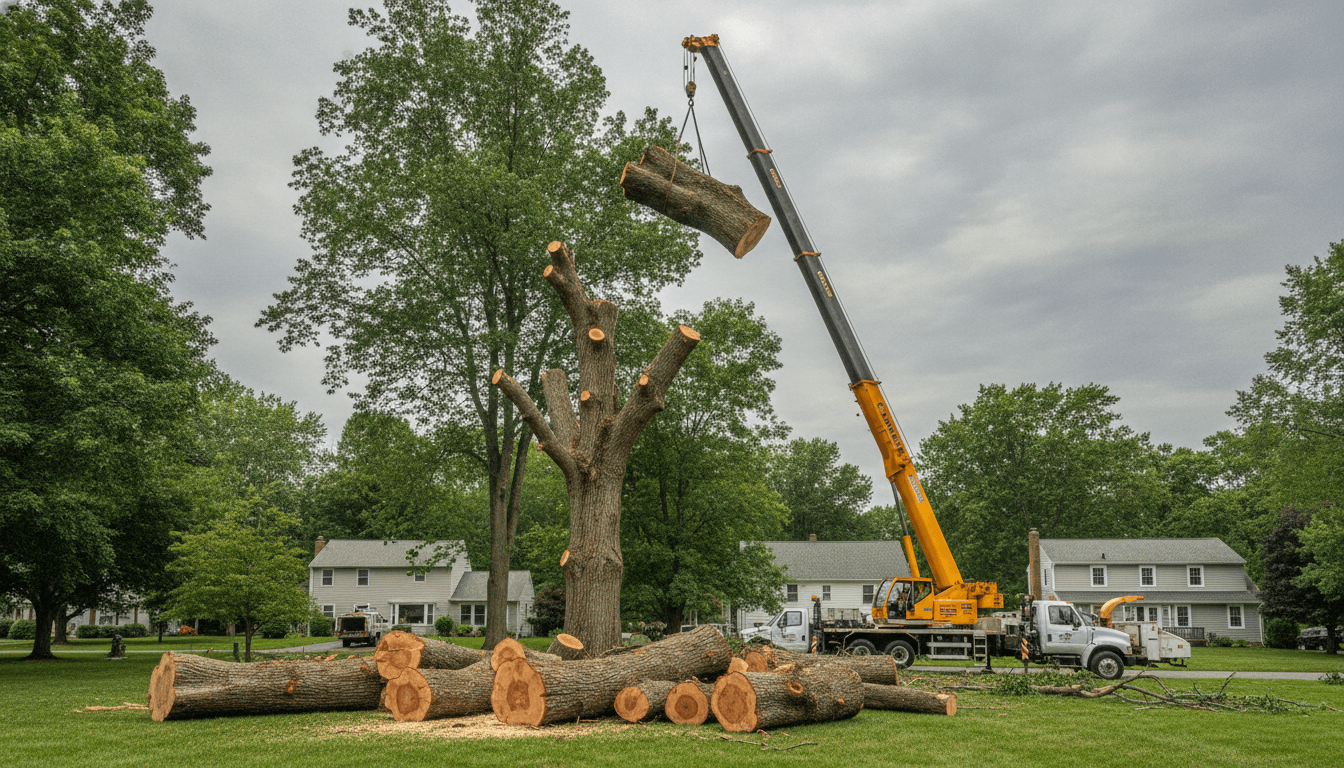
Proximity to a structure is the multiplier. An open drop takes a fraction of the labor of a technical removal where every limb comes down on a rope. A pine within reach of a house, a garage, a septic field, or a power drop can double or triple the base cost, because the crew has to rig, lower, and stage each section.
Access decides which equipment shows up. A yard with a wide driveway and firm ground takes a bucket truck and a chipper. A backyard behind a stone wall on a wooded lot in Hollis, NH gets climbers and hand carrying, which adds hours.
Species matters more than homeowners expect. White pine and hemlock come down relatively predictably, while mature oak and sugar maple weigh far more per foot of trunk, which means heavier rigging and more dump runs.
Standing dead trees carry a premium of 20 to 40 percent because the wood cannot be trusted under a climber's weight.
Common New Hampshire Tree Jobs and What They Run
Stump grinding is almost always separate. Expect $3 to $6 per inch of stump diameter with a minimum of $100 to $180, so a 24 inch pine stump runs $110 to $150 and a 40 inch maple runs $180 to $240. Grinding below grade for replanting or lawn costs more than a surface grind.
Debris handling is the other separated line. Some New Hampshire companies haul everything and charge accordingly. Others chip on site and leave the chips, which saves $150 to $400, and plenty of homeowners take the logs cut to stove length as firewood at no charge or a small credit.
Pruning and crown reduction run $350 to $1,200 for a mature tree. Removing deadwood over a driveway or raising the canopy over a roof line falls at the low end. Reducing the crown on a large maple to correct years of storm damage sits at the top.
Emergency work after a storm is priced differently from scheduled work. A tree on a roof or across a driveway in the hours after a nor'easter runs $1,500 to $5,000, and rates run one and a half to two times normal because crews are working nights and weekends.
Cabling and Bracing as an Alternative
Not every problem tree needs to come down. A mature oak with a co-dominant stem and an included bark union can often be cabled and braced for $500 to $1,500, which is a fraction of a $3,000 removal and keeps a fifty year old shade tree in the yard.
An arborist assessment costs $150 to $400 and is worth it before committing to a removal on a tree you value. New Hampshire has a licensed arborist program administered through the Department of Agriculture, Markets and Food, and a licensed arborist can tell you whether the tree is a genuine hazard or a manageable one.
Winter Work and Off-Season Pricing
January through March is the cheapest window for scheduled tree work in this state, often 15 to 25 percent below summer pricing. Frozen ground carries equipment without rutting the lawn, leafless crowns are easier to assess and rig, and crews have open calendars between storms.
The catch is snow depth and driveway access. A crew cannot get a chipper up an unplowed camp road in Carroll County in February, so the discount applies mainly to homes with maintained access.
Signs a New Hampshire Tree Should Come Down
Fungal conks growing out of the trunk or the root flare are the clearest warning available. Shelf fungus means internal decay is already advanced, and a pine or maple with conks at the base is compromised regardless of how full the canopy looks.
Watch the lean. A tree that has always leaned is usually fine, since it grew reaction wood to compensate. A tree that started leaning after a storm, especially with cracked or heaved soil on the opposite side of the root plate, is a different situation and worth an assessment quickly.
Dead limbs in the upper crown, bark falling away in sheets, and a hollow sound when the trunk is struck all point the same direction. So does a canopy that leafed out noticeably later or thinner than its neighbors two seasons running.
Emerald ash borer has moved through much of southern New Hampshire, and dying ash are now a routine removal here. Dead ash become brittle fast and dangerous to climb within a couple of years, so an ash showing crown thinning and woodpecker damage is cheaper to remove now than later.
Insurance, Licensing, and the Questions to Ask First
Tree work has one of the highest injury rates of any trade, and an uninsured crew on your property makes you the insurer. Ask for a certificate of general liability insurance and workers' compensation sent directly from the agent, not a copy handed over by the salesperson.
New Hampshire requires businesses with employees to carry workers' compensation coverage. A company that says its climbers are independent contractors and therefore exempt is describing a situation where an injured climber's claim lands on your homeowners policy.
Ask whether the crew includes a licensed arborist, how they plan to protect the lawn and the septic field, who is responsible for calling in utility locates before stump grinding, and whether the price includes hauling. Get all of it in writing before anyone starts a saw.
Comparing three written bids from licensed tree service companies serving your town on identical scope is the practical way to see who is guessing at the job. Our New Hampshire home service cost guides break down the same comparison for other trades.
Utility Lines, Town Rules, and Trees on Property Lines
Trees touching a power line are not your job. Eversource and the New Hampshire Electric Cooperative handle vegetation within their clearance zone at no cost to the homeowner, and no private tree company should be working within ten feet of an energized primary line without utility involvement.
The service drop from the pole to your house is a different question. That segment is often the homeowner's responsibility, and a removal near it requires a temporary disconnect arranged in advance. Building that into the schedule adds a few days, so mention the drop when you request the estimate.
Town rules vary. Trees within a public right of way or a scenic road designation may require town approval before removal, and New Hampshire has a number of designated scenic roads where roadside trees over a certain diameter are protected. Shoreland Protection Act rules also limit tree cutting within 250 feet of a lake, pond, river, or coastal water, and violations carry real penalties.
A tree on a property line belongs to both owners under New Hampshire law, and neither can remove it unilaterally. You may trim branches overhanging your side back to the boundary, though you cannot damage the tree's health doing it. Get the neighbor's agreement in writing before scheduling a boundary tree removal.
Common Questions About Tree Removal in New Hampshire
Does homeowners insurance cover tree removal?
Usually only when the tree has already fallen and damaged a covered structure, and even then most policies cap removal at $500 to $1,000. A hazardous tree still standing is a maintenance expense, and carriers decline those claims routinely.
When is the best time to remove a tree in New Hampshire?
Late winter, from January through March, delivers the lowest prices and the least lawn damage because frozen ground supports the equipment. Emergency removals after a December ice storm are the most expensive work of the year.
How much does it cost to remove a large white pine?
A mature white pine of 70 to 90 feet typically runs $1,400 to $3,200 depending on how much rigging the location demands. Pines within reach of a house or a septic system can push past $4,000 because every section has to be lowered by rope rather than dropped.
Do I need a permit to remove a tree on my own property?
For most inland residential lots, no. Properties within 250 feet of a lake, pond, river, or the coast fall under the Shoreland Protection Act with real cutting limits, and trees in a right of way or along a designated scenic road may require town approval first.